Bunny Munro's relationship as a son to his father
The Death of Bunny MunroBunny Munro’s relationship with his father is marked by a difficult inheritance: Bunny credits him with raising him and teaching him what he knows, yet their contact is strained by the older man’s hostility and by his contempt for Bunny’s livelihood. The bond is not simply a story of rejection. Lessons pass from father to son and from Bunny to Bunny Junior, but the family’s idea of “the business” becomes a point of conflict rather than a secure legacy.
Upbringing and Inheritance
Bunny describes his father as having raised him pretty much on his own and taught him everything he knows. He offers this account while speaking to River, after she expresses sympathy for him. The statement gives the relationship a foundation of acknowledged dependence: whatever their later conflict, Bunny understands his father as the principal source of his upbringing and practical knowledge. His formulation is expansive, but it does not specify which lessons he means or present their shared past as uncomplicated.
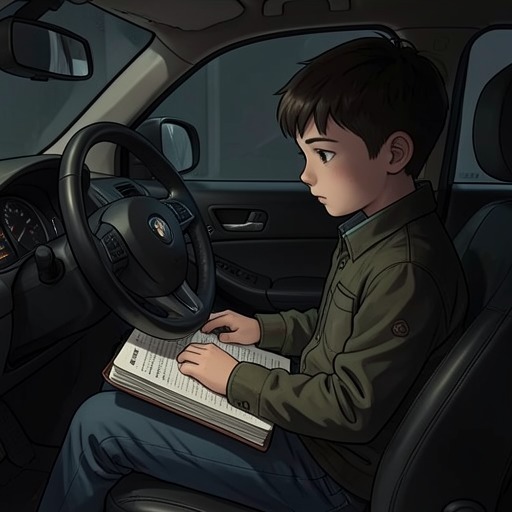
The language of instruction returns when Bunny is travelling with Bunny Junior. Driving the Punto slowly through the Wellborne Estate in Portslade, he begins an analogy about approaching a large oak or elm and shaking it. Bunny Junior admits that he does not know what happens, but listens closely and expects he may understand later. The scene presents Bunny in the teaching role his own father occupied for him. The lesson is delivered during a working trip, while Bunny searches the estate for a customer’s flat using Geoffrey’s list; instruction, work, and family life occupy the same cramped setting.
That transmission is not shown as a simple repetition of wisdom. The tree analogy remains incomplete in the available exchange, and Bunny Junior’s response is patient rather than proof that he has understood. What the scene establishes is the act of teaching itself: Bunny expects to pass knowledge on, while his son receives it without yet knowing its meaning. Against Bunny’s claim that his own father taught him everything, the moment makes inheritance feel provisional—something offered now and perhaps understood only later.
Contact and Estrangement
News that Bunny’s father needs him arrives through Geoffrey. A woman identifying herself as the father’s carer has called the office and says Bunny must go to his father’s place because the situation is urgent. Bunny’s brief response conveys exasperation, but Geoffrey makes clear that he is only relaying the message. The father’s need therefore enters Bunny’s life indirectly, through a workplace contact and a carer, rather than through a direct appeal between father and son.
Bunny later calls his father from home. Before placing the call, he has been drinking; he pours another drink as he dials, and his hand is unsteady. The call begins with prolonged coughing at the other end. Bunny addresses the person as his father, but the older man demands to know who is calling. When Bunny identifies himself again, the question is repeated in more hostile terms. The exchange turns a basic attempt at contact into a test of recognition, and Bunny’s stammer and shaking make his distress visible without his explaining it.
After ending the call, Bunny imagines his father as a skeletal figure in an old leather armchair, coughing and snarling into the telephone. The image is Bunny’s fearful projection, not a neutral account of what the father looks like. He closes his eyes, but the imagined figure persists; he resolves to try again another time. The delay leaves the urgent message unanswered in this scene. His response suggests both the pull of obligation and an inability, at that moment, to remain in contact with the father whose recognition he has sought.
Defending His Father
Bunny’s attachment becomes more explicit when Poodle makes a disparaging remark about how Bunny turned out. Bunny reacts slowly, then warns Poodle not to say anything else about his father or he will strike him. Poodle, already impaired and slumped on the sofa, does not hear the threat. The exchange shows Bunny defending his father’s place in his life even while the phone call has made their current relationship appear hostile and unstable.
The defense is significant because Bunny does not answer Poodle by denying that he has struggled or by describing his father as gentle. Instead, he draws a boundary around the father himself. His earlier account of being raised and taught by him gives this anger context: an insult directed at the father seems to touch the source of Bunny’s own formation. The scene does not resolve whether Bunny’s loyalty rests on affection, gratitude, habit, or some combination; it shows that the bond remains emotionally charged enough to provoke a sharp response.
The Business and Its Rejection
The clearest conflict over inheritance emerges when Bunny takes Bunny Junior to see his father. The older man angrily threatens a woman who has apparently crossed him, then turns to Bunny and says he tried to teach him the business and showed him what a boy could see. He immediately contrasts that claimed instruction with Bunny’s present work selling toilet brushes. The father’s complaint makes commercial failure, as he defines it, a judgment on Bunny’s use of what he was taught.
This dispute also throws Bunny’s own lessons to Bunny Junior into sharper relief. On the road, Bunny asks his son whether he would rather stay with his father and learn the business or return to school. When Bunny Junior instead mentions his sore eyes and fear that he may be going blind, Bunny insists that he answer the choice. The episode shows Bunny presenting work and apprenticeship as a route to becoming somebody, while his son’s immediate concern goes unanswered. The father-to-son pattern is therefore not only instruction but pressure: Bunny repeats the authority of a parent demanding that a child accept his definition of a worthwhile future.
The older man’s dismissal of toilet-brush selling and Bunny’s insistence that Bunny Junior learn the trade form two sides of the same inheritance. Bunny has not, in his father’s view, carried the business forward successfully; nonetheless, he treats it as knowledge worth passing on. Their relationship thus remains unresolved between gratitude and reproach, and between the wish to inherit a father’s instruction and the difficulty of living up to the standard that father sets.